



Email: sales@prodrill.com.cn
Tel:0086-18959243380
Addr: Room 805 C1 Wanda Plaza, No.5 Jinzhong Road, Huli District, Xiamen, China

Research on Technical Selection and Engineering Application of Symmetrix Overburden Drilling System
30 Jun 2026
Summary
Concentric casing system are a high-tech and structurally complex product series in the field of rock drilling tools, widely used in water well drilling, geological exploration, and foundation construction under complex geological conditions. Based on years of engineering practice in drilling tool sales and export, this paper systematically elaborates on the key parameter system for selecting concentric casing drill bits, deeply compares and analyzes the structural characteristics and applicable working conditions of the two mainstream technologies, ROBIT and ATLAS, and discusses optimized configuration schemes for drill bits under different casing wall thicknesses using engineering case studies. Research shows that scientifically sound parameter acquisition, targeted structural design, and differentiated scheme formulation based on working conditions are key elements to ensure the successful implementation of Symmetrix Overburden Drilling System projects. This paper aims to provide technical reference for the design, selection, and engineering application of concentric casing drill bits.
Keywords: Symmetrix Overburden Drilling System tools; technology selection; ROBIT structure; ATLAS structure; casing drilling
1 Introduction
Symmetrix Overburden Drilling System is an effective method for addressing drilling challenges in complex geological formations. Its core lies in the coordinated operation of the drill string and casing. Symmetrix Overburden Drilling System uses a central drill bit and a reaming assembly (ring bit + casing shoe) surrounding the central drill bit to impact and break the rock to create a borehole. Simultaneously, the reaming assembly 's reaming effect guides the casing into the hole. Compared to eccentric casing drilling, Symmetrix Overburden Drilling System better solves problems such as stuck drill bits and drilling into isolated rocks caused by complex geological conditions, is more conducive to construction operations, and improves drilling efficiency.
With the continuous advancement of global infrastructure construction and the increasing demand for water resource development, the Symmetrix Overburden Drilling System tool market is showing a steady growth trend. Statistics show that the global Symmetrix Overburden Drilling System tool market size was approximately US$924 million in 2024 and is projected to reach US$1.227 billion by 2031. Against this backdrop, how to efficiently and correctly provide customers with suitable Symmetrix Overburden Drilling System tool products and solutions has become a core issue for drilling tool sales and technical service professionals.
This article, drawing on the author's many years of practical experience in drilling tool sales and exports, systematically reviews and deeply analyzes the technical selection of Symmetrix Overburden Drilling System tools from the perspectives of customer inquiry parameter collection, product structure comparison, selection key points, and engineering cases.
2. Key Parameter System for Concentric Drill String Inquiries
In the sales and technical service of concentric casing drill bits, the initial inquiry parameters provided by customers are often incomplete. To ensure accurate selection, sales personnel need to guide customers to provide the following six core parameters:
(a) Outer diameter of the casing. The outer diameter of the casing determines the final borehole diameter and is the primary parameter for selection.
(ii) Heir pipe inner diameter. The outer and inner diameters of the heir pipe together determine the wall thickness. Currently, the mainstream concentric drilling tools have two main specifications for heir pipe wall thickness: no more than 6.5mm (typical value is 6.35mm) and no more than 10mm. There are significant differences between heir pipes with wall thicknesses of 6.35mm and 10mm in terms of connection method, drill tool structural design, and pipe extraction process.
(III) Inner Diameter of the Circular Bit. The inner diameter of the circular bit determines the casing size. Taking the SOD168 circular bit as an example, when the inner diameter is 135mm, a 127mm casing can be easily run through. This parameter directly affects the casing's adaptability and the smoothness of casing running.
(iv) Connection methods between the reaming assembly and the casing. Currently, there are four main connection methods: threaded connection, welding, soft cable (soft pin) connection, thermo-press connection (the annular drill bit and casing shoe cannot be separated), and no connection. Different connection methods determine the recyclability of the drill bit and the construction process.
(v) Customer's drilling plan. This includes drilling depth, formation conditions, drilling angle, etc., and is an important basis for selection.
(vi) Pump diameter. The water pump in the well is placed at the bottom of the well. The diameter of the water pump should generally be smaller than the inner diameter of the annular drill bit to ensure that the water pump can be successfully lowered to the designed depth.
Only after obtaining all six parameters mentioned above can we proceed with drawing design, technical solution formulation, and quotation. Production can only begin after customer confirmation.
3. Comparative Analysis of ROBIT and ATLAS Structures
Currently, the mainstream technology for concentric casing drill bits mainly originates from two major systems: ROBIT and ATLAS. Each structure has its own characteristics and is suitable for different engineering conditions.
3.1 ROBIT Structure System
The core advantage of the ROBIT structure lies in its excellent compatibility, maximizing its ability to meet the drilling requirements of ultra-deep wells. Depending on the casing wall thickness, the ROBIT structure is mainly available in the following models:
For casing with a wall thickness of 6.35mm, the SOD168 concentric casing drill bit ( drawing number 414140 ) is used. The outer diameter of the annular drill bit is 185mm, the inner diameter is 142mm, and the diameter of the center drill bit is 154mm. The casing shoe and the reamer are connected by corrugated thread or welding, and can be recovered when the casing is pulled out.
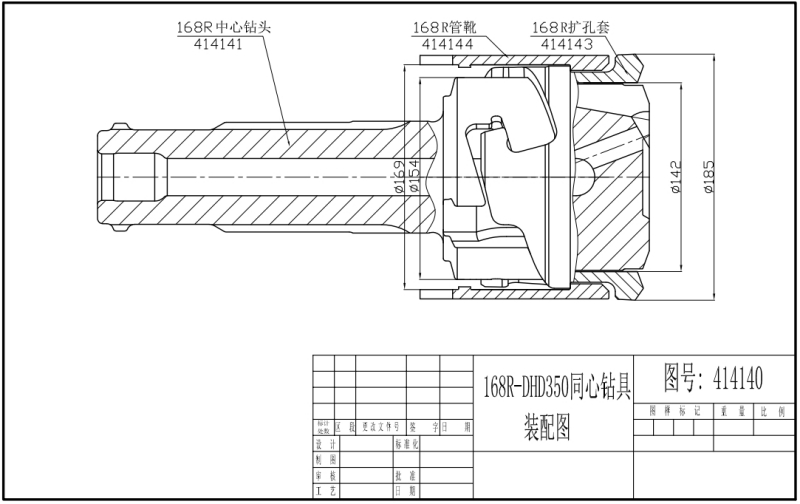
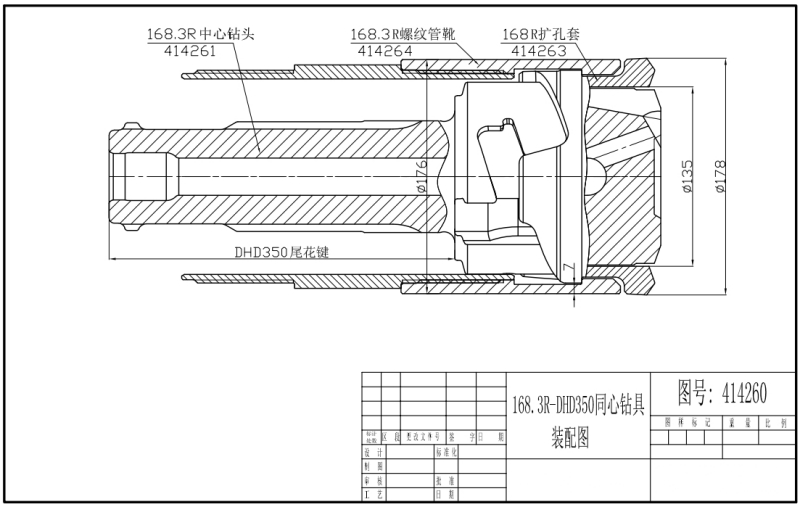
For 10mm thick casing, the SOD168 concentric casing drill bit ( drawing number 414260 ) is used, with an outer diameter of 178mm, an inner diameter of 142mm, and a center drill bit diameter of 146mm. The casing shoe and the reamer are connected by a corrugated thread, which can be recovered when pulling the casing.
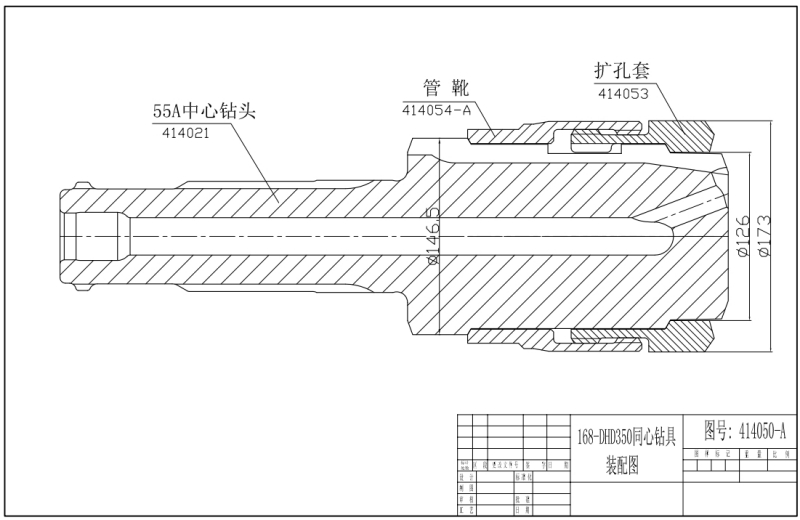
Another ROBIT structure ( drawing number 414050 ) is designed for 10mm thick casing pipes. It features a 173mm outer diameter and 126mm inner diameter annular drill bit, with a center drill bit diameter of 146.5mm. Its distinguishing feature is the welded connection between the casing shoe and the reamer. The annular drill bit's outer diameter is smaller than the 178mm of the 414260 structure, resulting in lower pipe pulling resistance. It is widely used in China.
A key feature of the ROBIT structure's concentric tube is the presence of three hooks, a design that plays a crucial role in the tube extraction and recovery process.
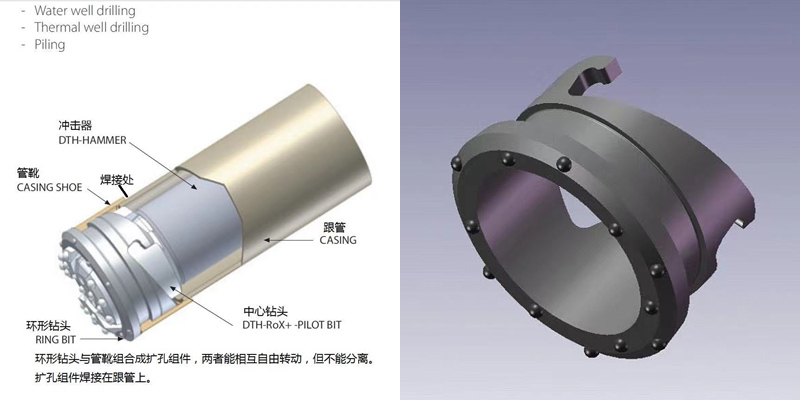
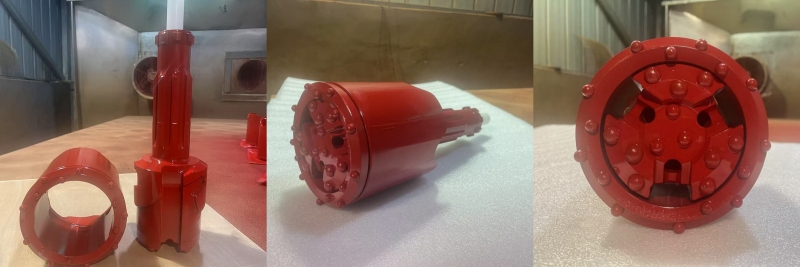
This is a 3D assembly diagram of the ROBIT structure and a schematic diagram of the annular drill bit. The slot uses a helical loading method: that is, the central drill bit rotates downwards, while the reaming assembly ( annular drill bit + pipe shoe ) can be easily installed.
3.2 ATLAS Structure System
The ATLAS Symmetrix concentric casing system can drill straight holes over 100 meters deep at any angle (including horizontal). Its three main components include a center (guide) bit, a casing shoe, and a ring bit.
For casing with a wall thickness of 6.35mm, the ATLAS structure ( drawing number 414210 ) has an outer diameter of 183mm, an inner diameter of 132mm, and a center drill diameter of 154mm. The casing shoe and the reaming sleeve are connected by a soft cable (soft pin). When pulling out the casing, the reaming assembly remains in the hole, and the annular drill does not come out with the casing.
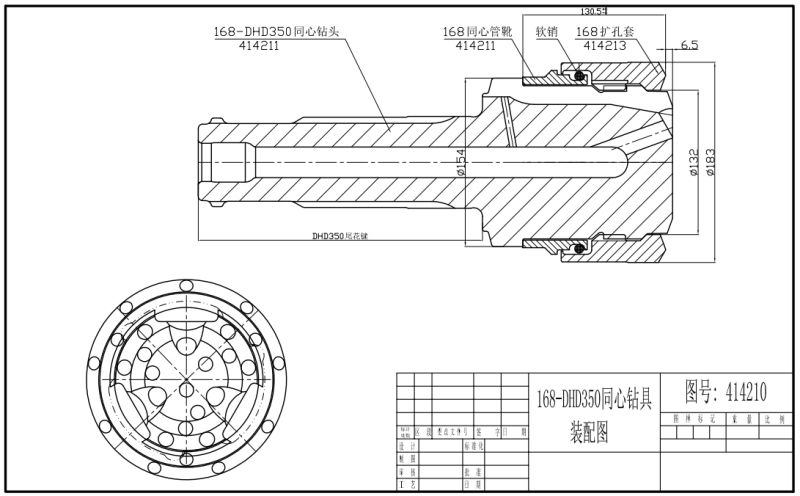
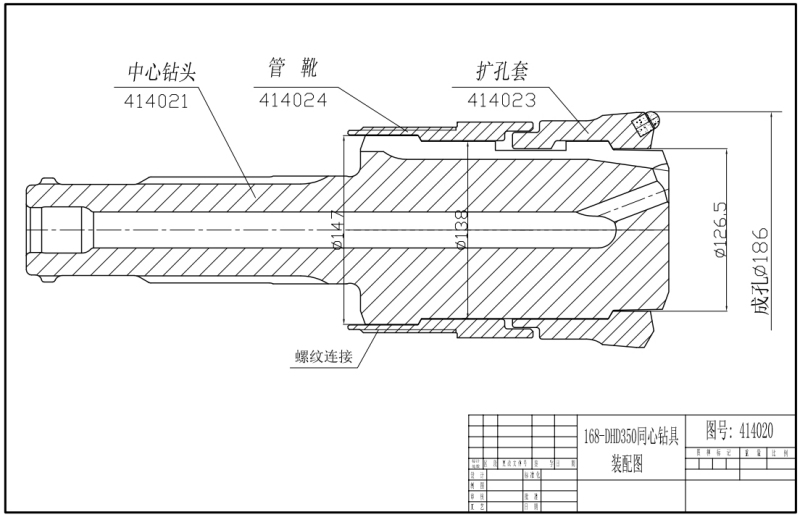
For casing with a wall thickness of 10mm, the ATLAS structure (drawing number 414020) has an outer diameter of 186mm, an inner diameter of 138mm, and a center drill diameter of 147mm. The casing shoe and the reamer are not connected; the reamer remains inside the hole during casing removal.
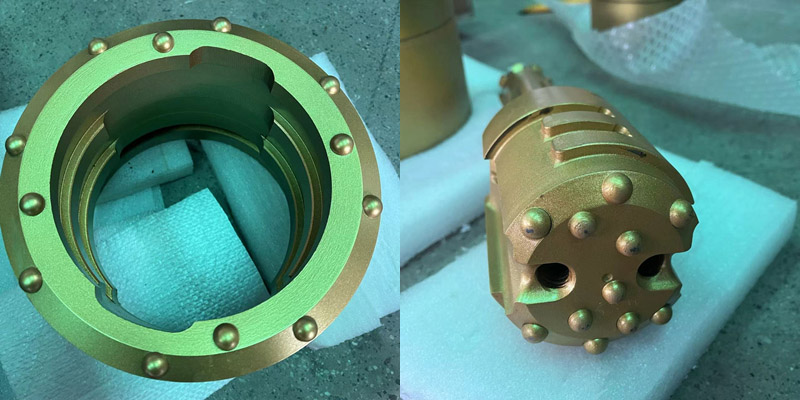
This is the ATLAS structure. The circlip drill bit has a protrusion inside the hole that must be aligned with the center drill bit's discharge groove before it can rotate. Only the center drill bit can be mounted onto the circlip drill bit. Secondary alignment and mounting become more challenging when the workpiece is at the bottom of the hole.
3.3 Technical Comparison of the Two Structures
In summary, the main differences between the ROBIT and ATLAS structures are as follows:
Regarding the inner diameter of the annular drill bit, the inner diameter of the ATLAS structure annular drill bit is generally smaller than that of the ROBIT structure. The smaller inner diameter means that, under the same casing outer diameter, the ATLAS structure annular drill bit has a thicker wall and higher strength, but it may also lead to limited space in the pump.
In terms of compatibility, the ROBIT structure offers superior compatibility, especially in ultra-deep well drilling. The ROBIT structure can be configured with different specifications of reaming components such as SOD273, SOD219, and SOD168 to form a stepped casing, enabling drilling into deeper holes.
Regarding pipe pull-out and recovery, the ROBIT structure allows for the recovery of the circumferential drill bit and pipe shoe during pipe pull-out; while with the ATLAS structure, whether using cable connections or not, the reaming sleeve and circumferential drill bit typically remain inside the hole. The choice of structure depends on a comprehensive consideration of geological conditions and budget.
4. Technical matching between pipe wall thickness and connection method
4.1 Technical solution for 6.35mm wall thickness pipe
When the wall thickness of the casing is less than or equal to 6.35 mm, the casing is usually welded together, and the casing is unlikely to be pulled out. Under this condition, regardless of the structure of the annular drill bit or reaming assembly used, it will remain inside the hole.
For 6.35mm thick casing, if the customer requires a corrugated thread connection between the casing and the reamer (non-extraction casing solution), the ROBIT design ( drawing number 414140 ) is recommended. This solution has been validated in overseas markets such as Chile—a Chilean customer once ordered 100 sets of SOD168 concentric drill bit reamer assemblies, adapted to 6mm thick casing, using a corrugated thread connection.
4.2 Technical solution for 10mm wall thickness pipe
For tubes with a wall thickness of no more than 10mm, the tube shoe and tube can be welded or made into a threaded connection. When connecting the tube, a corrugated thread connection can be used when the wall thickness is large, which has a long thread life; when the tube wall is thin, a trapezoidal thread can be used to ensure the tube wall thickness at the thread as much as possible.
The ROBIT structure offers two options for 10mm thick casing: drawing number 414260 (outer diameter 178mm, corrugated thread connection, recyclable) and drawing number 414050 ( outer diameter 173mm, welded connection, recyclable). The latter is more commonly used in China, as its annular drill bit has a smaller outer diameter than the former, resulting in lower casing pull resistance.
4.3 Explanation regarding consistency with original manufacturer design
In the actual production of concentric casing drills, special attention must be paid to customer requirements for consistency with the original manufacturer's design. Taking the ROBIT structure as an example, when the reaming assembly and casing are connected by threads, due to die length limitations, the lugs must be eliminated when the total thread length is 85mm. This change will affect the mating pattern of the annular drill bit and the center drill bit. Therefore, for customers who require complete consistency with the original manufacturer's design, thorough communication and confirmation are necessary during the design phase.
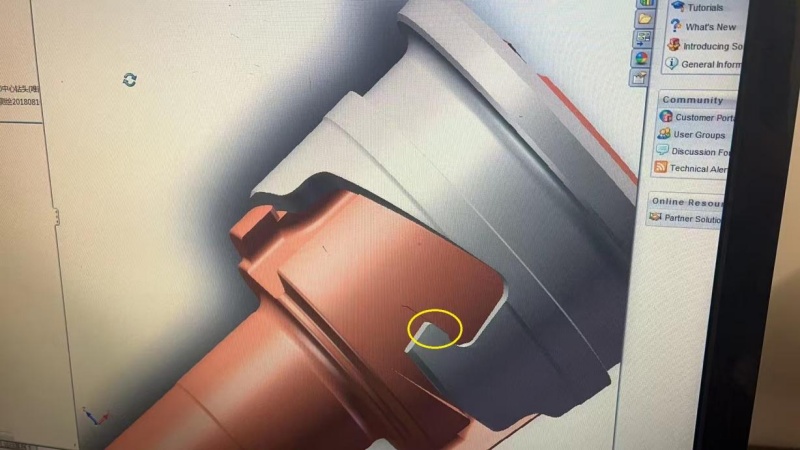
Before modification
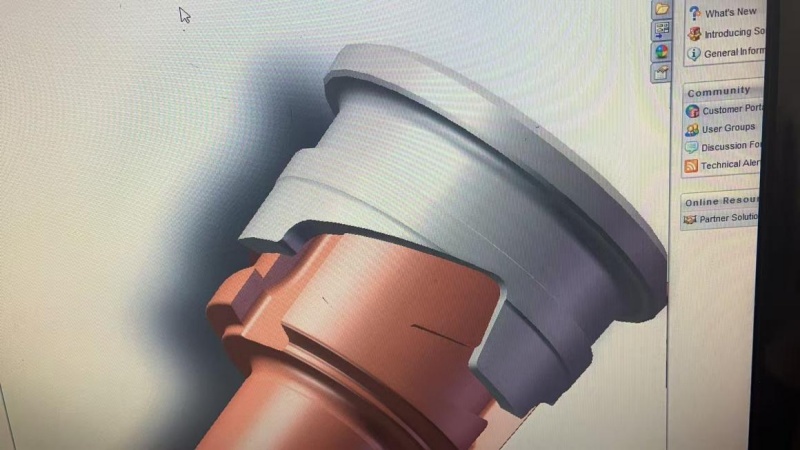
After modification
5. Step-drilling technology and engineering applications
A major technical advantage of Symmetrix Overburden Drilling System tools is their ability to enable stepped casing drilling. Taking water well drilling as an example, when drilling to a depth of 400 meters is required, a stepped approach can be used, employing three specifications: SOD273, SOD219, and SOD168, each drilling 100 meters. The core advantage of this technology is:
Firstly, by gradually reducing the diameter of the casing, drilling resistance can be effectively reduced and drilling efficiency improved. Secondly, in complex geological conditions, stepped casing can reduce the risk of stuck drill bit. Thirdly, different specifications of reaming components can be recycled and reused, reducing project costs.
The ROBIT structure performs particularly well in this process, with its SOD168, SOD219, and SOD273 reaming components forming a complete series of stepped tubes. Accompanying video materials demonstrate the feasibility of this process. This is one of the key reasons why the author recommends the ROBIT structure.
6. Conclusion
The selection and design of Symmetrix Overburden Drilling System tools is a systematic project that requires comprehensive consideration of multiple factors, including casing dimensions, wall thickness, connection methods, drilling plans, and supporting equipment. Based on the analysis in this paper, the following conclusions can be drawn:
(1) Complete collection of inquiry parameters is a prerequisite for ensuring accurate selection. All six parameters are indispensable: outer diameter of casing, inner diameter of casing, inner diameter of ring drill bit, connection method, drilling scheme and water pump diameter.
(2) The ROBIT structure and the ATLAS structure each have their applicable working conditions. The ROBIT structure has good compatibility and is suitable for ultra-deep well drilling and stepped casing technology; the ATLAS structure has unique advantages under specific working conditions. Sales personnel need to recommend the most suitable solution based on the customer's actual needs and geological conditions.
(3) The wall thickness of the casing is a key factor in determining the connection method and the structure of the drill bit. Wall thicknesses of 6.35mm and 10mm correspond to different design ideas and process schemes and should not be used interchangeably.
(4) For customers who require consistency with the original manufacturer's design, the technical details must be fully confirmed during the design phase to avoid product differences due to mold limitations or other reasons.
With the continued growth of the global Symmetrix Overburden Drilling System tool market, a deep understanding of product technical characteristics, accurate grasp of customer needs, and provision of differentiated technical solutions will become the key for drilling tool companies to enhance their core competitiveness.
References
[1] Casing drilling [EB/OL]. Baidu Encyclopedia, 2025.
[2] Research Report on the Development Trends and Development of Symmetrix Overburden Drilling System Tools 2026-2032 [R].
[3] Global Symmetrix Overburden Drilling System Tool Industry Survey and Trend Analysis Report - 2026 [R].
[4] Global and China Symmetrix Overburden Drilling System Tools Market Size Survey and "15th Five-Year Plan" Forecast Report [R].
[5] Products | Robit Plc[EB/OL]. www.robit.fi.
[6] Atlas Symmetrix One-Time Ring Drill Bit System [EB/OL].
appendix:
Drawing Display: Comparison Chart of Drawing Numbers for SOD168
Drawing numbers: 414140, 414260, 414050, 414210, 414020