




Email: sales@prodrill.com.cn
Tel:0086-18959243380
Addr: Room 805 C1 Wanda Plaza, No.5 Jinzhong Road, Huli District, Xiamen, China

Drilling and completion construction plan and drill string selection technical evaluation for oil shale deep well (1600m) development project
22 Jul 2026
Abstract: As an important unconventional oil and gas resource, the efficient development of oil shale poses severe challenges to drilling and completion engineering technologies. This paper takes a deep oil shale well development project in Algeria as the research object, systematically describing the layered construction scheme and drill string selection for the first stage of surface drilling and technical casing drilling, and the second stage of production well drilling. It focuses on analyzing two key optimization measures and their technical and economic value: upgrading the original Φ219mm casing to Φ244.5mm standard technical casing and using a Φ215.9mm PDC full-face drill bit to reach the target depth in one pass. Combining the technological advancements of Chinese drilling tool companies in materials science, precision manufacturing, and system-wide support, this paper demonstrates the inherent logic behind the leap from "usable" to "easy-to-use" drilling tools. Research shows that deep well drill string selection has shifted from competition based on single product performance to competition based on system solutions encompassing "product + technology + service." The Chinese drilling tool industry is leveraging the dual-engine drive of basic materials research and precision manufacturing processes to fundamentally enhance its position in the global value chain. This paper can provide a reference for drilling scheme design and drill string selection for similar deep well projects.
Keywords: oil shale deep well; drilling and completion scheme; technical casing; PDC drill bit; drill string selection
1 Introduction
1.1 Research Background and Significance
Against the backdrop of global energy structure transformation, oil shale, as an unconventional oil and gas resource with abundant reserves, is seeing continuous and intensified exploration and development efforts. Oil shale deposits are generally located at great depths, with strong reservoir heterogeneity and poor drill ability, placing extremely high demands on drilling and completion technologies and equipment. Ultra-deep well drilling is widely recognized in the industry as "mobile aerospace engineering" and is a crucial indicator of a country's or region's drilling technology level.
Algeria possesses abundant oil shale resources, ranking among the world's top in technically recoverable oil shale resources according to the U.S. Energy Information Administration (EIA). In a well construction project in an oil shale block in Algeria, Chinese drilling companies were deeply involved and successfully provided key drilling tools and technical services, marking a new milestone in the competitiveness and influence of China's drilling industry in the international high-end market.
1.2 Research Objectives and Content
This paper takes the exploitation project of a deep oil shale well (designed depth 1600m) in Algeria as the engineering background, and conducts a systematic analysis and technical evaluation from four dimensions: construction plan, process design, drill string selection, and engineering application. The aim is to:
(1) Analyze the key technical logic of the deep well drilling and completion layered construction scheme;
(2) Analyze the core considerations for matching drill string selection with wellbore structure;
(3) Evaluate the technical performance and value contribution of Chinese drilling tools in this project;
(4) Summarize the internal mechanisms and development direction of China's drilling tool industry in achieving technological leaps.
2. Wellbore Structure and Construction Scheme Design
2.1 Overall Design Concept
This well is an oil shale production well with a designed depth of 1600m, employing a two-stage drilling strategy. The first stage involves surface and technical casing drilling, aiming to provide a safe passage to the deeper production well bore. The second stage is production well bore drilling, with the goal of penetrating the target oil shale layer and completing the installation of the production casing. This "segmented protection and step-by-step isolation" design concept reflects the core principles of "safety first, quality priority" in deep well drilling engineering.
2.2 First Stage: Surface and Technical Casing Drilling
The first phase of the design involves a seven-layer casing procedure to isolate unstable formations and shallow fluids layer by layer. The specific scheme is shown in Table 1.
Table 1. Drilling Scheme for 1600m Deep Wells in Algerian Oil Shale
|
Drilling plan for 1600-meter deep wells in Algerian oil shale |
|||||
|
Serial Number |
Product Name |
Drill bit/pipe dimensions (mm) |
Drilling depth (m) |
Cumulative depth (M) |
Analysis of phase goals |
|
1 |
Concentric casing drill bit |
φ430 |
0-40 |
40 |
The φ431 hole was drilled using the largest diameter drill bit, and the first layer of surface casing was installed to isolate the loose topsoil layer. |
|
2 |
Concentric casing drill bit |
φ406 |
40-80 |
80 |
The φ406 casing undergoes its first diameter reduction. Drilling continues within the upper casing layer, with a smaller diameter casing being lowered in. |
|
3 |
Concentric casing drill bit |
φ381 |
80-120 |
120 |
φ381 continued to run casing to further solidify the wellbore. |
|
4 |
Concentric casing drill bit |
φ324 |
120-160 |
160 |
The φ324 technology and casing layer are typically used to isolate complex formations. |
|
5 |
Concentric casing drill bit |
φ305 |
160-200 |
200 |
φ305 Continue constructing the "pipe-following tower" |
|
6 |
Concentric casing drill bit |
φ279 |
200-240 |
240 |
The φ279 size (11” inch) is often used as an important technical tube size. |
|
7 |
Concentric casing drill bit |
φ244.5 |
240-450 |
450 |
A φ244.5 casing (approximately 85/8 inches) was run up to 450 meters, providing an "entry point" and support for all subsequent small-diameter drilling. |
|
8 |
PDC All-Around Drill Bit |
φ216(QL60) |
450-650 |
650 |
Drill directly to the target depth of 1600 meters using a standard 8 1/2-inch PDC drill bit. This drill bit can pass smoothly through a φ244.5mm casing. |
|
9 |
PDC All-Around Drill Bit |
φ181(QL60) |
650-850 |
850 |
|
|
10 |
PDC All-Around Drill Bit |
φ171(QL60) |
850-1050 |
1050 |
|
|
11 |
PDC All-Around Drill Bit |
φ165(QL60) |
1050-1250 |
1250 |
|
|
12 |
PDC All-Around Drill Bit |
φ152(QL60) |
1250-1450 |
1450 |
|
|
13 |
PDC All-Around Drill Bit |
φ140(QL60) |
1450-1650 |
1650 |
After drilling to the target depth, a standard φ139.7mm production casing is lowered in. This is a very common production casing size. |
Among these, the upgrade of the original Φ219mm casing to Φ244.5mm (9⅝ inch) standard technical casing in Stage 7 is a key optimization measure. The technical and economic value of this upgrade is reflected in three aspects: First, Φ244.5mm is a widely used size series in API standards, with mature and stable supply channels for compatible accessories; second, increasing the casing inner diameter provides ample annular space for subsequent installation of larger production tubing, significantly reducing flow resistance in oil production operations; and third, it provides operational margin for potential secondary cementing or workover operations. The feasibility of this change is based on the premise that the Φ244.5mm casing meets the formation load conditions below 450m in terms of crush resistance, internal pressure resistance, and tensile strength.
2.3 Second Stage: Production Well Drilling
The second stage uses a Φ215.9mm (8.5-inch) PDC full-face drill bit to drill from 450m to the target depth of 1600m in one pass. This drill bit can pass smoothly through a Φ244.5mm casing and drill a well bore with regular dimensions. After reaching the target depth, a standard Φ139.7mm (5.5-inch) production casing is run in.
The rationale for this scheme lies in the fact that Φ215.9mm is one of the most mature wellbore sizes for medium and deep wells in the world, and it is equipped with a complete set of drilling tools, logging instruments, and cementing tools; the PDC full-face drill bit can complete a continuous drilling section of 1150m in a single well entry, avoiding the time consumption of multiple trips in and out of the well, and greatly improving the pure drilling efficiency.
3. Key Drilling Tool Selection and Technical Analysis
3.1 Drilling tool configuration for the opening section
For the 0-40m borehole section, a Φ431mm drill bit was used for lead-in. Considering the tendency of the loose surface layer to collapse, surface casing was immediately run in and cemented after drilling through. The core consideration for the selection of drill string for this section was not drilling efficiency, but rather the versatility of the borehole and the stability of the wellhead, which laid the foundation for all subsequent drilling operations.
3.2 Drilling Tool Configuration for Technical Casing Section
The 40-450m well section adopts a multi-layer casing nesting structure, and the core logic of its drill bit selection is "decreasing size and step-by-step isolation". The diameter of each drill bit is left with sufficient annular space clearance compared to the outer diameter of the casing of the previous level to ensure smooth casing running operations.
It is worth noting that the installation of the two-stage technical casing with diameters of Φ279mm and Φ244.5mm effectively sealed off the shallow aquifer and mudstone creep layer that are common in this block, preventing formation fluid from flowing upward and wellbore instability, and creating good wellbore conditions for safe deep drilling.
3.3 Selection of PDC Drill Bits for Production Wells
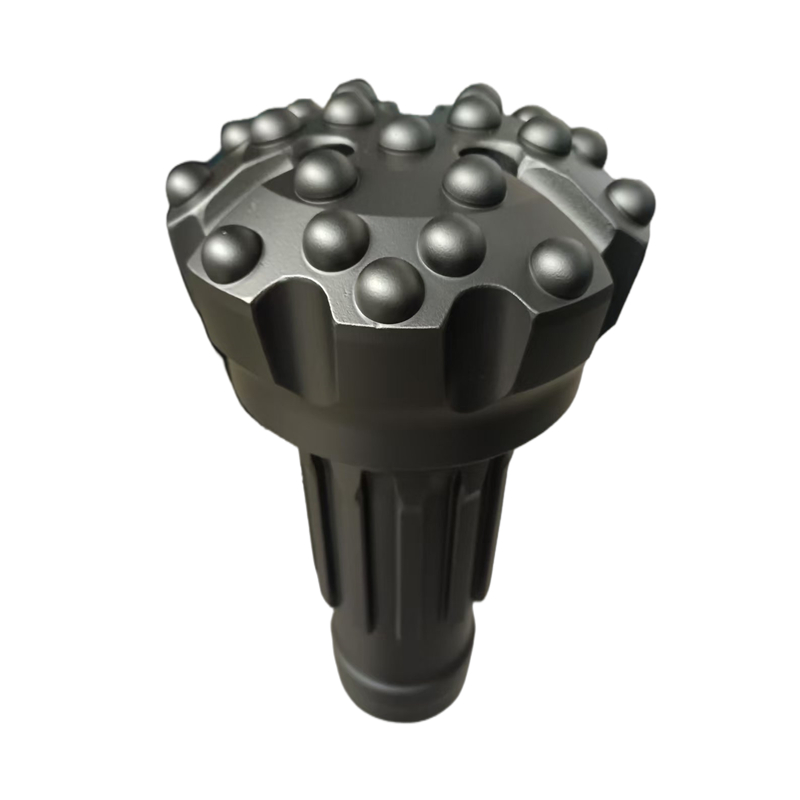
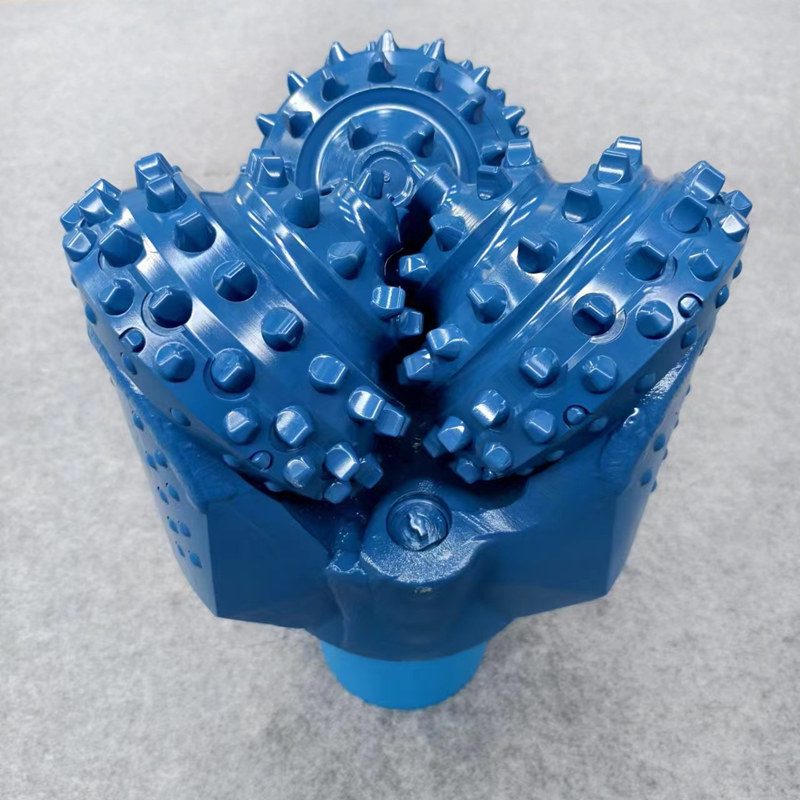
The Φ215.9mm PDC full-face drill bit is one of the most technologically advanced drill tools in this well. The core challenges faced by the PDC drill bit in drilling oil shale formations include:
(1) Oil shale has well-developed bedding, which makes it easy to generate periodic torque fluctuations during drilling, requiring high impact toughness of the drill bit;
(2) The bottom temperature in deep well sections (below 1000m) can reach 80-100℃, which poses a challenge to the thermal stability of PDC composite sheets;
(3) The drilling footage is as long as 1150m, requiring the drill bit to have both high drilling speed and long service life.
The PDC drill bit selected for this project adopts a high-impact-resistant PDC composite plate and an optimized hydraulic structure design, which enhances the gauge retention capacity and erosion resistance while ensuring the drill bit's offensive capabilities.
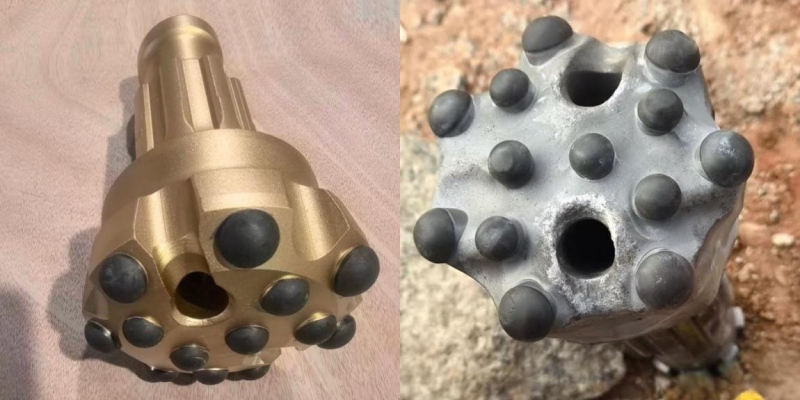
PDC All-Around Drill Bit
3.4 Application of concentric casing drilling tools
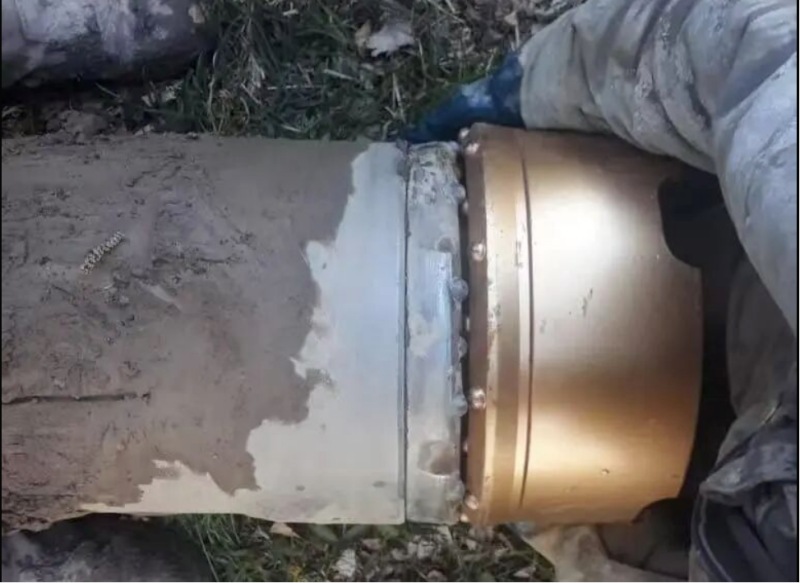
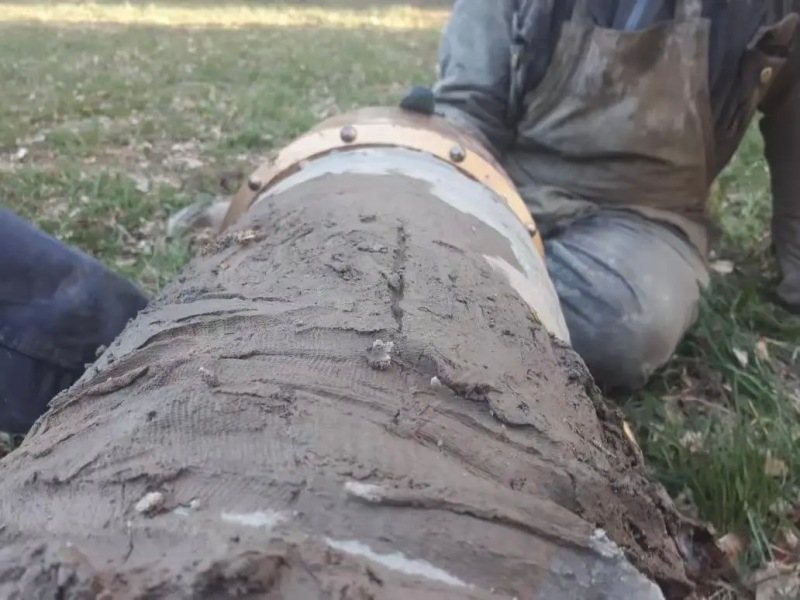
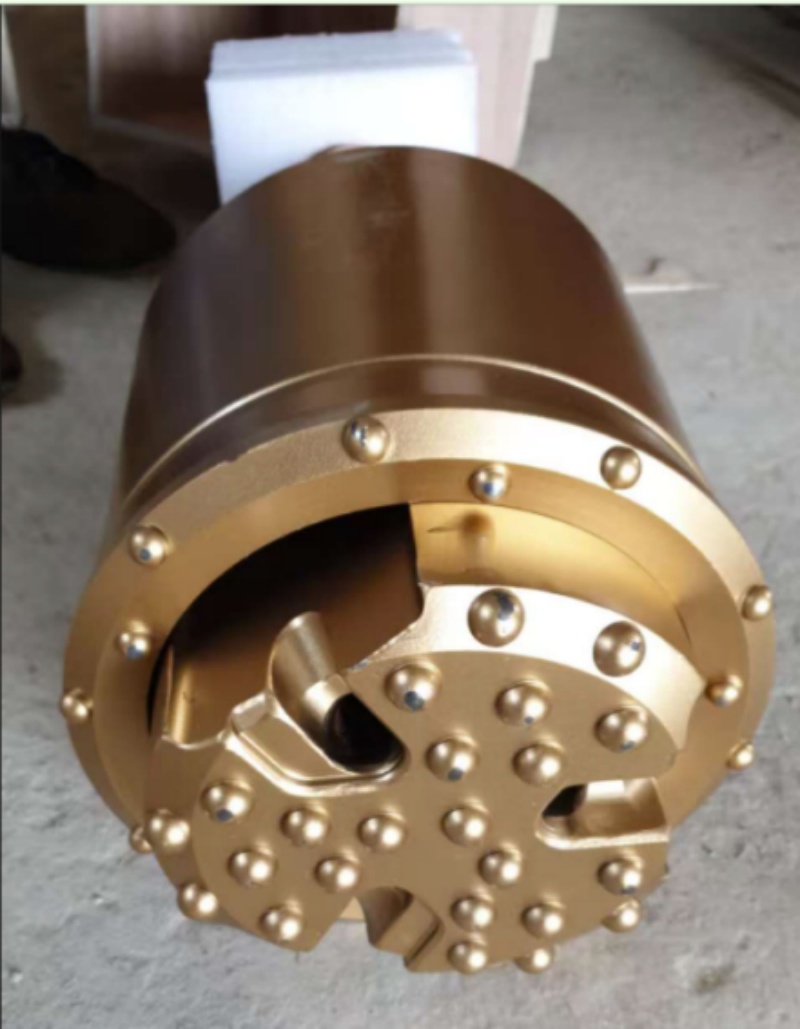
In this project, concentric casing drilling tools were innovatively introduced into the deep well drilling technology of oil shale. In loose surface and shallow unstable formations, concentric casing drilling allows for simultaneous drilling and casing installation, effectively preventing borehole collapse and over-diameter runs, and ensuring the casing is successfully lowered to the designed depth. Compared to eccentric casing drilling tools, concentric casing drilling tools offer superior maneuverability and operational reliability when dealing with boulders and complex formations. The matching accuracy between the central drill bit and the concentric reamer directly determines the success rate of casing drilling. The following figure shows a concentric casing drilling tool.
4. Key Technology Optimization and Engineering Practice Evaluation
4.1 Forward-looking design for casing upgrades
Upgrading the Φ219mm sleeve to a Φ244.5mm technical sleeve is the most representative "Chinese solution" in the design optimization of this project. The technical logic of this change includes at least three levels:
Level 1 (Geometric Matching): The Φ244.5mm casing provides sufficient passage space for the subsequent Φ215.9mm drill bit (casing inner diameter approximately 224mm, annular clearance approximately 8mm), while the original Φ219mm scheme (inner diameter approximately 200mm) cannot meet the passage requirements of the Φ215.9mm drill bit. In other words, there is a structural contradiction between the Φ219mm scheme and the two-stage drilling scheme, making an upgrade necessary rather than contingent.
Tier Two (Standard Fit): Φ244.5mm (9⅝ inches) is an internationally recognized standard casing size. The matching cementing accessories, hangers, and wellhead equipment are all mature off-the-shelf products, with short procurement cycles and reliable quality. Φ219mm, however, is a non-preferred series and carries procurement risks within the global supply chain.
Level 3 (Strategic Vision): Larger-sized technical casing provides margin for wellbore lifecycle management—whether it's future sidetracking, deepening, or workover operations, ample annular space provides valuable operational space.
The optimization suggestion put forward by Xie Linhui, a senior engineer at Hunan Jiezuan Company, reflects the profound understanding and flexible application capabilities of Chinese drilling engineers in different global oilfield standard systems. It is also a micro-level reflection of the Chinese drilling industry's shift from "technology following" to "technology parallelism".
4.2 Economic Evaluation of Long-Foot Drilling with PDC Drill Bits
Using a Φ215.9mm PDC drill bit to achieve continuous drilling of 450–1600m (1150m of footage per well entry) is a technologically advanced decision. According to project test data, the high-quality PDC drill bit shortened the drilling cycle of this well by approximately 60%, saving approximately US$400,000–500,000 in investment per well.
The reduction in drilling cycle time has a multiplier effect on the overall cost of deep well drilling: on the one hand, it is reflected in the direct savings in drilling rig day costs (deep well drilling rig day costs are typically in the range of US$20,000 to US$50,000); on the other hand, time-dependent costs such as mud consumption, cementing materials, and logging services are reduced simultaneously. For a production well with a total cost of US$3 million to US$5 million, a saving of US$500,000 is already quite considerable.
4.3 The Technical Logic of Systematic Matching
The size matching of the Φ215.9mm drill bit and the Φ244.5mm upper casing, as well as the hydraulic and cementing matching of the Φ139.7mm production casing and the Φ215.9mm open hole section, together constitute a complete "drilling tool ecosystem." Chinese drilling tool companies in this project did not provide a single drill bit or a single casing, but rather a meticulously calculated, systematic combination of tools.
The establishment of this systematic matching capability is based on a complete product line, accurate dimensional chain calculations, and a thorough understanding of API/ISO standards. The completeness of China's drilling tool "toolkit" means that mature domestic solutions are available for every key node, from drilling bits to casing hangers.
5. The Intrinsic Logic of China's Drilling Technology Leap Forward
5.1 Profound Breakthroughs in Materials Science
Ultra-deep well drilling places comprehensive challenges on drilling tool materials. The high-temperature (>100℃) environment at the bottom of the well requires continuous improvement in the thermal stability of PDC composite plates; highly abrasive formations require a better balance between the wear resistance and impact resistance of cemented carbide; and CO₂/H₂S-containing formations require drilling tool materials to have sufficient corrosion resistance.
The technological advancements in China's drilling tool industry in recent years are rooted in the deep integration of the domestic basic materials industries, such as drill steel, cemented carbide, and super hard composite materials. The advancement of the national strategy of "strengthening the foundation of materials and revitalizing the industry through tools" has significantly shortened the feedback cycle between basic materials research and drilling tool applications, forming a virtuous cycle of "application driving R&D, and R&D feeding back into application." This is the fundamental guarantee that drilling tools can "crack" hard formations, maintain high-speed drilling, and have a long service life.
5.2 System upgrade of precision manufacturing processes
The strength of each tooth socket, the tooth placement angle, and the back rake angle design of each cutting tooth in a drill bit directly affect the success or failure of drilling operations. The overall digital and intelligent transformation and upgrading of China's manufacturing industry has provided the drilling bit industry with key technological guarantees such as precision machining, controlled atmosphere heat treatment, vacuum brazing, and online quality inspection.
The precision of each process is continuously improving. The cumulative effect of this "micro-innovation" has enabled domestically produced drilling tools to gradually approach or even surpass international top brands in two core indicators: lifespan and drilling speed.
5.3 A fundamental shift in the export competition model
The profound lesson from the Algerian project is that the main battleground for competition in high-end drilling tool exports has shifted from price competition to competition based on systemic capabilities encompassing "products + technology + services." This reflects the underlying industrial logic behind the structural adjustment of cemented carbide sheet prices in recent years, spearheaded by state power—by bringing upstream material value back to its original level, the downstream drilling tool industry is being forced to break free from the low-end lock-in of low-price competition and move towards the high end of the value chain.
As the industry consensus reveals, the foundation of a "drilling tool powerhouse" lies in a "drill tool industry powerhouse." Building a "drill tool industry powerhouse" is not an unattainable goal, but is being forged through breakthroughs in tungsten industry technology, upgrades in the cemented carbide industry, research and development of new materials, and the production of every meticulously crafted drill tool product.
6. Conclusions and Outlook
This paper systematically analyzes the drilling and completion plan, drill string selection, and key technology optimization of a deep (1600m) oil shale well development project in Algeria, and draws the following conclusions:
(1) Layered casing design (gradually transitioning from Φ431mm to Φ244.5mm) is an effective way to build the integrity of deep well casing. The optimized scheme of upgrading Φ219mm to Φ244.5mm technical casing reflects the accurate grasp of international standards and engineering practice.
(2) The technical solution of completing 1150m continuous drilling in one go with the Φ215.9mm PDC drill bit significantly shortens the drilling cycle while meeting the well bore quality requirements. Actual measurement data shows that the drilling cycle is shortened by about 60%, and the investment per well is reduced by about US$400,000 to US$500,000, demonstrating the decisive influence of efficient drilling tools on the construction cost of deep wells.
(3) The successful application of Chinese drilling tools in this project is based on the two cornerstones of materials science and precision manufacturing, and is a concentrated manifestation of the system solution capability of "product + technology + service". The leap from "usable" to "easy to use" marks a substantial improvement in the global competitiveness of China's drilling tool industry.
(4) Looking ahead, the global demand for deep-earth resource development will continue to grow, and the market space for deep well drilling tools is vast. China's drilling tool industry should continue to deepen basic materials research, improve the precision manufacturing system, strengthen on-site technical service capabilities, and promote the comprehensive transformation of the export competition model from price-driven to value-driven.
This project demonstrates that Chinese drilling tools have the complete capability to provide systematic solutions in the international high-end market, and the position of Chinese manufacturing in the global energy equipment value chain is achieving a qualitative leap.