




Email: sales@prodrill.com.cn
Tel:0086-18959243380
Addr: Room 805 C1 Wanda Plaza, No.5 Jinzhong Road, Huli District, Xiamen, China

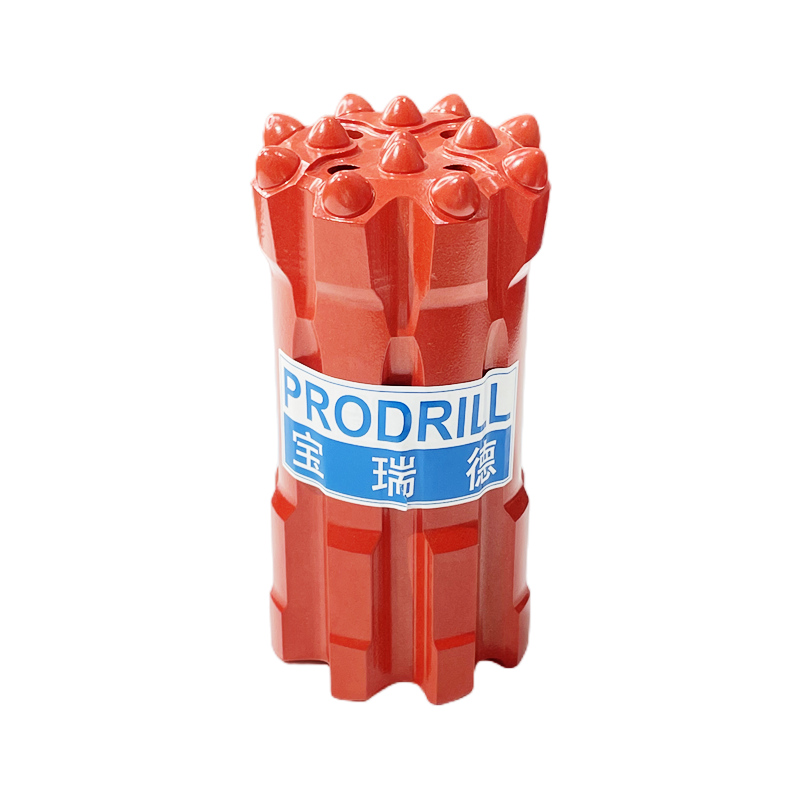
Key points of threaded column tooth drill bit trouser body machining technology
06 Feb 2026
The machining quality of the threaded rod bit body directly determines the assembly reliability, impact energy transmission efficiency, and bit lifespan.
一.Unified Machining Datum
Ensure a unified machining datum throughout all processes, including turning the outer diameter, turning the thread, and milling the slag removal groove, to prevent coaxiality deviations caused by datum conversion.
二.Precision Control of Key Components
1.Core Machining Requirements for Threaded Parts
Threaded parts are the core connection components. It is essential to ensure that the threads conform to the drawing requirements, with precise thread dimensions and tooth profile accuracy, and well-controlled dimensional tolerances. Avoid excessive clearance leading to impact energy loss, or insufficient clearance causing assembly jamming. Surface quality control: The thread surface and uncut areas must be free of scratches, dents, burrs, oxide scale, and other defects.
2.Machining Requirements for Slag Removal Structure and Transition Zones
Machining of powder removal troughs and holes: Strictly adhere to the dimensions specified in the drawings. The trough opening, bottom, and edges must have a radius (R) transition. Sharp corners are strictly prohibited—they easily lead to rock powder accumulation and blockage, and also create stress concentration points. For all transition zones, including the connection between the tapered surface and the outer circle, the outer circle and the end face, and the slag removal trough and threads, all connections must be machined according to the designed radius of curvature in the drawings. Right-angle transitions are strictly prohibited. After machining, a manual inspection should be conducted to ensure there are no steps or burrs, effectively reducing the risk of stress concentration under impact loads.
三. Surface Treatment
Comprehensive deburring treatment: all burrs on the machined surfaces must be completely removed, with special attention to the thread root, tooth edge, and corner of the empty tool groove: use manual grinding (with fine sandpaper) to deburr, ensuring no burr residue and avoiding scratching the drill rod thread surface during assembly.
四. Process Inspection and Quality Control
1. Inter-process Inspection
100% inspection is required after each critical process. Thread dimensions are checked using thread gauges (GO and NO-GO gauges); thread surface, thread clearance, and transition zone radius are inspected visually and by touch.
2. Final Finished Product Inspection
Assembly Trial Fitting: Trial assembly is performed using thread gauges and standard matching drill rods. The screwing process should be smooth and without jamming, with uniform tightening torque.
Currently, foreign drilling tool manufacturers generally use multi-axis machining centers and centralized processing steps to produce drill bit bodies. This method requires significant equipment investment, offers stable product quality control, and reduces labor intensity, but its processing efficiency is relatively low. In contrast, domestic drilling tool manufacturers typically employ decentralized processing steps and specialized equipment to manufacture drill bit bodies; some companies also utilize robotic arms. This method is highly efficient, has low equipment investment costs, and provides very stable quality control. In the production and processing of drill bit bodies, domestic rock drilling tool manufacturers have fully reached international advanced levels, producing high-quality drill bit bodies with high efficiency and low cost.